
How to Respond to “How Are You?” When You’re Not Okay (Holiday Edition)

Embracing Authenticity During the Season of Stress
The holidays arrive draped in tinsel, twinkle lights, and a massive, invisible banner that reads: BE JOYFUL.
For many, this season is a beautiful time of connection and tradition. But for just as many, it is a period of heightened stress, logistical nightmares, financial strain, and profound loneliness. If you are one of the many adults who already feels worn out, anxious, and overwhelmed—perhaps juggling high-stress work scenarios, managing complex family dynamics, or simply navigating a world that often demands you mask your true feelings—the holidays can feel less like a break and more like a performance.
Then comes the question. It’s unavoidable, almost a reflex, delivered by everyone from the grocery store clerk to your estranged uncle: “How are you?”
And if you’re not okay, what are you supposed to say? The pressure to deliver a cheerful, socially acceptable answer—“I’m great! So busy! Happy holidays!”—can feel like a weight added on top of everything you’re already carrying. The expected ‘I’m fine’ can start to feel like a lie you’re repeating dozens of times in just a few weeks. That constant dissonance between your internal reality and the external performance becomes its own kind of exhaustion, leaving very little space for authenticity or real connection.
At Kitchen Table Psychotherapy, we believe in shedding the mask. We specialize in helping anxious and burnt out adults and couples reclaim a sense of control and authenticity. This holiday season, reclaiming control starts with your response to this simple, yet loaded, four-word question.
This comprehensive guide offers a toolbox of responses designed not to create drama, but to protect your peace, honor your truth, and ensure your limited holiday energy is spent wisely. We will explore responses that range from polite deflection to genuine connection-seeking, giving you the language you need to navigate the emotional minefield of holiday socializing.
Why “How Are You?” Is Harder During the Holidays
To understand how to answer, we must first validate why the question feels so exhausting right now. The difficulty isn't just about feeling bad; it's about the dissonance between your internal experience and the external pressure for holiday cheer.
The Tyranny of Toxic Positivity: The holidays are the peak season for toxic positivity. There is a deeply ingrained cultural expectation that you must be doing well, excited, and grateful. Admitting you are struggling feels like failing the season, a form of social failure that draws unwanted scrutiny or pity. When you are feeling anxious or depressed, the pressure to be happy often makes you feel worse, as if your genuine emotions are inconvenient or inappropriate.
Amplified Grief and Loss: If you are grieving a loved one, mourning a relationship, or experiencing complex family estrangement, the cultural emphasis on family togetherness can amplify the pain exponentially. Your internal state is a quiet storm, while the world outside is singing carols. Trying to articulate this depth of pain in a casual social interaction is an act of vulnerability few are prepared for, and even fewer askers are prepared to receive.
Increased Emotional Labor and Masking: You are likely engaging in more social interactions than usual—parties, dinners, travel. Every interaction demands a baseline level of emotional energy, and for those who are highly sensitive, neurodivergent, or people-pleasers, this constant masking drains the emotional tank rapidly.
Logistical and Financial Overwhelm: Coordinating travel, cooking, gift-buying, and managing schedules can be a lot. Trying to do everything can leave you with no energy left to manage your feelings, let alone articulate them to others.
Routine Disruption and Sensory Overload: For high-achieving individuals and neurodivergent folks, stable routines are a core grounding mechanism. The holidays disrupt the routine, leading to anxiety, sensory overload, and a general feeling of disorientation that makes everything feel more challenging.
When you are met with "How are you?" while standing on shaky ground, your authentic answer is often too complex and too vulnerable for a passing comment. But that doesn’t mean you have to lie. You can prepare and choose a response that serves your mental health.
The Holiday Response Toolkit: Strategies for Every Scenario
Your response should always be calibrated to two factors: 1) your current energy level, and 2) your relationship with the person asking. Here are categories of responses to choose from:
1. Low-Energy/Emotionally Neutral Responses: Preserving Your Reserve (The Default)
When your social battery is at 5% and your only goal is survival, these responses require minimal effort and shut down follow-up questions politely. They are brief, honest enough, and redirect the focus away from a deep dive into your emotional state.
"I'm here, and that feels like a win. How about you?" (The quick deflection.)
"Nervous about the traffic, but fine otherwise." (Focus on external, solvable stress.)
2. Boundary-Setting Responses: Controlling the Depth
For people who tend to pry, or when you simply do not want to use your limited energy to explain yourself, boundary-setting responses are critical. They are gentle yet firm, communicating that the subject is off-limits right now.
“That’s a big question. I’m not really up for getting into all of that right now, but I appreciate you asking.”
“I’m prioritizing connection over conversation today. Tell me about something good that happened to you this week.”
“Things are a bit intense right now, but I’ve set some strong boundaries for myself, so I’ll be okay. Thanks for checking in.”
“I’ve had a tough time, to be honest. But I’d rather talk about [safe, neutral topic, e.g., the new show we’re watching]—have you seen it?”
4. How to Answer When You’re Overwhelmed (Honest but Contained)
When you are truly on the brink of overload, suppressing the feeling can make it worse. These responses allow for a brief, authentic acknowledgment of stress without requiring a full emotional breakdown or explanation. They signal, "I'm not fine, but I'm managing it."
"Honestly, I’m feeling a little much right now. I’m just focusing on taking one breath at a time."
"A little overwhelmed, so I’m taking a moment to ground myself. Can I have some ice water?"
"I’m tired. The holiday pressure is really getting to me, but I'm here because I want to be."
"I’m okay, but only because I gave myself permission to say no to three things this week."
"I feel like I’m running on 30% battery, but I brought my emotional charger (a book/a quiet corner)."
5. Connection-Seeking Responses: Opening Up to those you trust
These responses are reserved exclusively for your closest, most trusted friends or family—those who can hold space for you without judgment. This is where you allow yourself to be truly seen.
"Not great, actually. I’ve been feeling really anxious/lonely/sad lately. I could really use a hug later, or just a few minutes to talk about it."
"It's been a tough year, and the crowd is making it worse. It means a lot that you asked."
"I’m genuinely struggling with [specific issue: grief, financial stress, burnout]. Could we maybe step away for five minutes and chat just the two of us?"
"I’m feeling really tender right now. I was hoping to see you because I knew you’d ask, and I needed someone to talk to."
"You know what? I’m exhausted. Thank you for asking. I needed to hear that someone cares."
Tailoring Your Truth: Responding Based on Relationship
The core of effective communication is context. Who is asking matters immensely, as your required level of emotional labor changes based on the relationship.
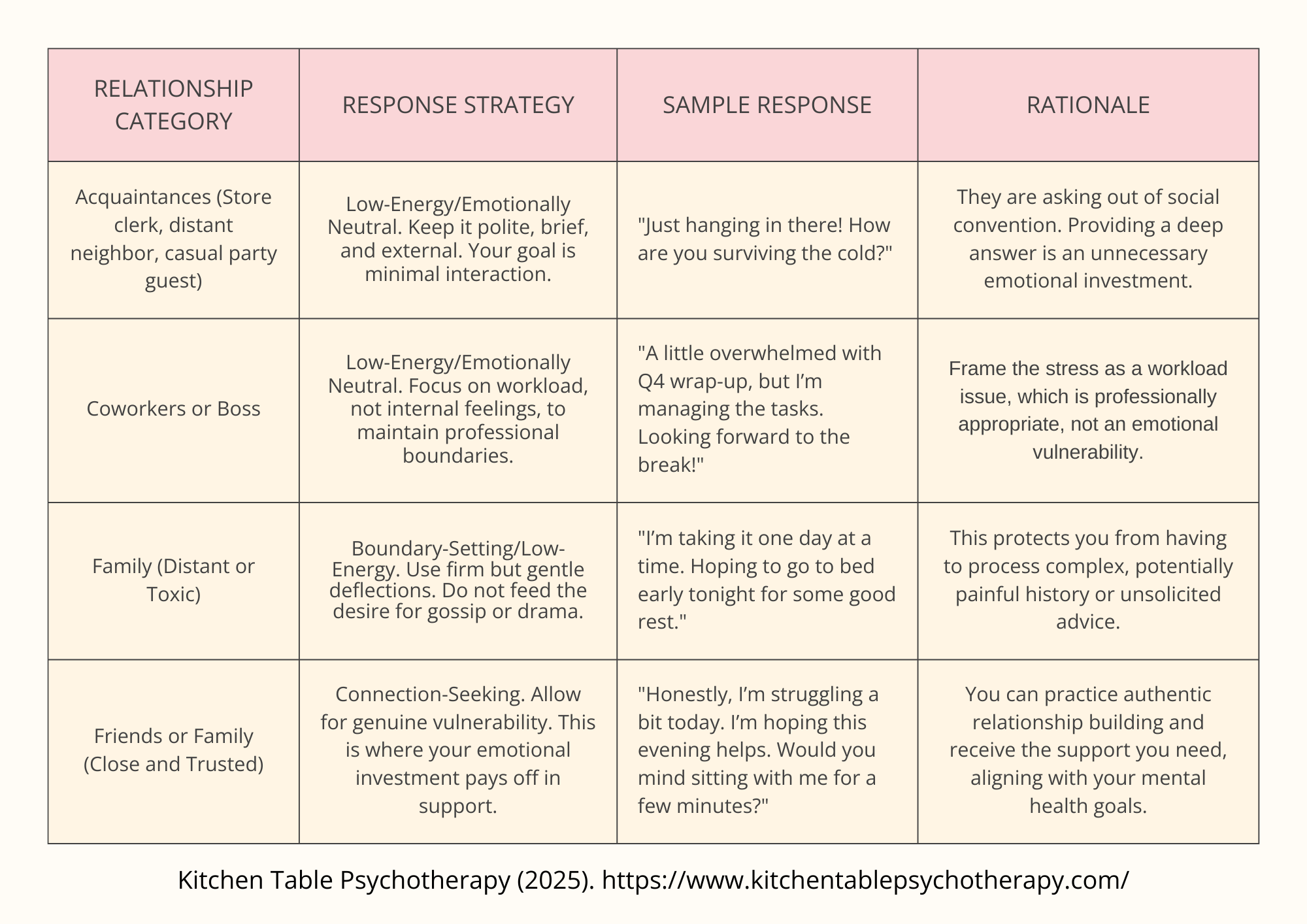
How to respond to "How are you" based on relationship types.
Finding Your Authentic Voice: A Final Note from Kitchen Table Psychotherapy
Some of the earliest and most meaningful work we do in the therapy room is giving yourself permission to be exactly where you are, without judgment. Therapy becomes a space where you can slow down, breathe, and be real.
Responding to "How are you?" when you are not okay is not a simple choice between lie and trauma dump. It is an act of self-advocacy.
It is an acknowledgement of your current capacity and a radical choice to honor your own needs first. By choosing a response from this toolkit, you are attuning to yourself and setting a boundary that protects your peace, preserves your energy, and allows you to build the kind of meaningful, connected relationships that accept the full spectrum of your human experience.
This holiday season, give yourself the gift of integrity. Be gentle with yourself. You are allowed to be busy, tired, anxious, or grieving, even if the world demands a smile. You are allowed to answer authentically, within the limits of your own boundaries. You are not required to perform joy for anyone.
May this season be one where you feel seen, valued, and empowered to respond with integrity, whether you are 100% full of holiday cheer or running quietly on fumes.
If you are feeling overwhelmed, anxious, or burnt out, especially while navigating the complexities of the holidays as a queer, POC, or neurodivergent adult, please know that you are not alone. Kitchen Table Psychotherapy offers a supportive, inclusive, and culturally affirming space to help you reclaim control, feel grounded, and heal. Reach out today to explore how we can support you in the new year.